1511 Maple Drive,
Hammond Ranch
CA 96094
Phone Toll Free
1-800-511-1337
email:
StefanBaumannArtist@gmail.com
“This workshop far surpassed all my expectations. I was impressed with the well-organized instruction of the basic principles and skills of painting during Stefan’s painting demonstrations. Throughout the weekend, he was attentive to my progress as I painted on-location. The evening critiques focused on both the positive and negative aspects of the day’s paintings, and became a teaching tool for improvements that I could implement during the next day’s work. It was fun to meet new people and share the weekend with such enthusiastic and dedicated artists. And, I came away with seven paintings of beautiful locations including waterfalls, mountains, meadows, and Mt. Shasta, which I can refine and finish in my studio at home. Fantastic! ”
Kris Baxter
Mt. Shasta, CA
Information
Tuition $350
Tuition does not include lodging and participants are required to find their own accommodations.
Deposit of $150 (non-refundable) is required to reserve your space in this workshop. Space is limited, and there is a “first come, first served” basis.
Deposit of $75 is required in advance for food for spouses and friends who are not painting, but want to eat at the Grand View ranch.
Make checks payable to Stefan Baumann and mail to:
The Grand View Ranch
1511 Maple Dr,
Hammond Ranch CA 96094
Payment can be made by credit card by calling
The Grand View Ranch at 415-606-9074.
Workshops in 2015 & 2016
- Oregon Coast "Lincoln City" June 26, 27, & 28 - 2015
- Bear Valley California September 25, 26, & 27 - 2015
- Vermont June 13, 14, & 15 - 2016
- Vermont October 3, 4, & 5 - 2016
Classes are limited and must be reserved with a deposit. Register online
- To be announced
- To be announced
Students must have all supplies listed.
Oil Paints
Cobalt Blue
Cadmium Yellow Light
Alizarin Crimson
Titanium White
Burnt Sienna
Viridian Green
Asphaltum
Medium:
Odorless paint thinner
Liquin
Brushes:
Bristle:#2,4,6,8,etc
Sable: Script Brush
Palette Knife
Umbrella
www.bestbrella.com/
Palette:
Wood or paper
Sketching Material:
Pencil, Eraser, Pencil Sharpener,or Charcoal
Canvas Board/Panels Only:
Required Size: 9x12
Amount: 10
Easel
EasyL Versa kit or Pro kit: www.artworkessentials.com
Roll of Paper Towel
Optional Paints
Cad Red Light
Yellow Ochre
Optional Brushes
Black Gold #4 Fan
Optional Equipment
Stool Or Chair
Suntan Lotion
Bug Repellant
Carpenter Clamps
Pliers
Brush Holder
Small Containers For Media
Bungie Cords
Luggage Carrier With Wheels
Hat With A Brim
Fingerless Gloves
Bottled water
Prospect
Camera
Canvas Carrier
(or pizza boxes)
Trash Container
The Grand View Thumb Box Students often say that it is cumbersome and 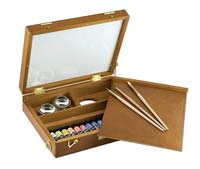 inconvenient to travel with paint supplies and canvas. I say nonsense! You may not have heard about this great little thumb box. This is a beautifully made replica of a 19th Century varnished beech wood paint box. Popular with artists because of its clever design and superb quality, it is the ideal artists traveling companion. This box can be taken on planes, and used with acrylic, water-based oils, or oil paint. It is fitted with a leather shoulder strap, and it is a must for hiking to locations in the great outdoors.
Click here for the Thumb Box website
Day One: Saturday
- Visualizing: Seeing Is Believing: Starting with a Concept
We will discuss why most paintings fail within the first ten minutes of starting a painting. Artists seldom take the time to develop a concept before they begin. Next, strategies that artists need to follow to create a good painting on location will be presented. We will discuss how painting is a creation of what you see, not what you see.
- Sketching and Composition
Throughout history, great art was produced using proven systems that were based on theories developed as early as the Greeks and Romans. Later, artists in the Renaissance rediscovered these principles, and this changed the way art has been created for fourteen hundred years. Students will be introduced to the principles of composition. Participants will be asked to make sketches of their compositions on location as an opportunity to practice these principles with their own work.
- The Mechanics of What Our Eyes See
Participants will explore how the eyes see objects in real life. Since we see differently than a camera, students will learn what helps to recreate realistic impressions of life.
- Color: The Art of “Less”: Limited Palette
Most students have issues when mixing color; others do well but feel that it is a trial and error process, and they hope for many happy accidents. In this discussion about mixing colors, participants will be introduced to the concept of a limited palette that allows artists to work with three colors plus white. Students will learn what they need to know about mixing color for their paintings. We also will talk about the value and temperature of color, and how they can work together dynamically in a painting.
- Chunking and Values: Structure and Abstract:
In this segment, students will learn how to lay out a foundation in a simple abstract manner. Students will start implementing the concepts of good composition, color, and value, and are encouraged to chunk-in their preliminary painting using visualization as a means to an end.
- Application: The Art of Painting
We will begin to discuss the application of paint. Students will see how to create luminous effects with dark values right from the start of a painting, and how to create the effect of light with the application of paint. Students will learn this process by “Painting Thin to Thick,” and focusing on the “Meeting of Edges,” and the “Central Focal Point.”
Day Two: Sunday
- Problem Solving: Working it out
Students will experience that drawing is very important to capture the essence of a landmark. We will also look at “Light and Dark Relationships” to create shapes, and proportions to capture scale.
- Alla Prima: The Act of Painting
What is Alla Prima painting and how is it done? We will explore how this style of painting can work for you. Qualities of “Paint Application” are also included in this discussion.
- Sense of place: The Feeling of the Location
Most paintings are the visual effect of an object that is in front of us. A good painting allows the viewer to understand the artist’s interpretation and response to what he sees as he paints. Students will become aware of the effect of light, and how light influences the viewer.
- Sense of Self: What and How You See
What we see is only part of what we want to paint. Creating art is different from just rendering an image on a canvas. One of the most reoccurring questions that artists ask is, “What is my style?” Your observations, insights, and thinking determine your artistic style, and this is what the world is waiting to see. We will identify the artistic “you,” and your artistic style in this important conversation.
- What is Art?
Participants will discuss what art is, and why it is important that we do this thing called "art.” Understanding this concept is important so that students comprehend the wonderful power they have being an artist. Whatever the creative activity - music, cooking, or painting, this theory applies to everything that we do in our life.
- Putting it All Together
In this last three-hour session, participants will share the new possibilities they have experienced for themselves with each other. Key discussions and critical insights will be revisited, deepening our understanding of the concepts presented over the weekend, and how they can apply to our art.
- Dealing Powerfully with Breakdowns
As we conclude the workshop, we will explore handling breakdowns effectively. Breakdowns are thoughts and feelings that stop us from painting successfully. We view what we create as something important, but the reality is far different. What we do is not who we are. In this session, we will focus on insights that can help repair breakdowns, and strategies that can help artists paint through their times of discouragement and frustration, to achieve success in their work, when painting on location or back in their studio.
Traveling
Participants can easily drive to every painting location. An Itinerary will be provided after registering for the workshop. This Itinerary may be updated, and any new information about your scheduled workshop will be given to you on the first day of the workshop. We often caravan to many of the vistas and locations by car, and maps with detailed directions will be provided. You can make your own arrangements if you want to drive alone. Carpooling is encouraged, and if you want us to help place you in a carpool, let us know and we will match you up with other participants with similar personalities and requirements.
The workshop locations are situated near our cars and trucks unless specified. Some bonus locations have been added, and are scheduled in the early morning or late afternoon so that participants who feel they are not up to a hike aren’t missing the workshop experiences.
There is no mass transit to Mt Shasta; people that are flying in from out of town or state are encouraged to rent a car to travel to Mt Shasta.
Flying
If you are flying to California from other states or countries to participate in our workshop, there are two options to choose. Both Medford, Oregon and Redding, California have airports and take one hour to drive to Shasta. Or, you can fly into San Francisco, check out a few museums, and drive up to Mt Shasta, and this takes about 5 hours to drive. Please feel to contact us about what might be the best option for you.
Spouses & Significant Others
For those of you who are coming to the Mt. Shasta Workshop but are not painting, there are many things to do and see in the Shasta area. Several students in the workshop are bringing partners and friends, and they may go on a hike, go to a spa, or fish together while we paint. Meals are offered at the Grand View Ranch, and spouses and friends are welcome to attend for a fee of seventy-five dollars that covers the cost of beverages and food. During the evening critiques, there will be a campfire where guests can relax and exchange scary stories about things that go bump in the night.
Personal Coaching
Personal Coaching accelerates your success and to help you get started, I have created an innovative program designed specifically with you in mind. I am available to work with you as your own personal painting coach. I will work with you by phone and on the internet, offering critiques and suggestions about how you can create masterpieces. If you are not in one of my classes, this is one of the fastest and easiest ways for you to reach your artistic goals. If you are serious about creating art, and motivated to do better, I recommend that you consider working with me as your own personal coach.